Saturday, 25 April 2020

Commemorating in quarantine.

So it's the night of another Anzac Day. The annual public holiday shared among three nations - Australia, New Zealand and Turkey - once enemies, now friends. Since 1916, it has grown in stature to become all three of those nations' citizens pause together to reflect on and give thanks for the sacrifices their forebears made in war. Its traditions and observances had been, pleasantly, unchanged ever since.

Until this year, of course thanks to the COVID-19 pandemic. Therefore, in 2020, Anzac Day in Australia, at least, has seen the same sentiments shared but markedly different ways. There have been no marches or massively-attended dawn services, no games of Two-Up in pubs, none of that. Just public but solitary performances of The Last Post (including one in my own housing estate, in fact, to my delight), and the regular social media statements and news coverage.

Nonetheless, I am very pleased the day and its remembrances have gone ahead despite the pandemic. I could say why, but nobody needs the sermon or the history lesson. Certainly not anybody from any of the three nations involved. I hate all wars generally and dislike militarism, but we must always remember the sacrifices which were made for our nations, and who made them.

We will remember them.

A bit too picky - News

Thursday, 16 April 2020

Something Cult, Foreign-Language or Indie #183: Train to Busan (2016).

Train to Busan' Movie Review - Clippings Autumn 2018 - Medium

Seok-woo (Gong Yoo) is a cynical, workaholic fund manager and divorced father in Seoul who, suddenly racked with guilt, agrees to take his lonely young daughter Su-an (Kim Su-an) to Busan by train for her birthday to visit her mother. Among the other passengers are working-class, expectant couple Sang-hwa (Ma Dong-seok) and Seong-kyeong (Jung Yu-mi), flirtatious young baseballer Yong-guk (Parasite co-star Choi Woo-shik) and his cheerleader crush Jin-hee (Sohee), arrogant express company COO Yon-suk (Kim Eui-sung), two elderly sisters (Yee Soo-jung and Park Myung-sin) and a homeless PTSD sufferer (Choi Gwi-hwa). Everything's going smoothly, until a sickly young woman runs unnoticed onto the train and becomes a zombie. Now, the train becomes beset with a zombie pandemic - just like all of South Korea, it turns out.

Train to Busan has been touted as Snowpiercer meets World War Z, and while I can understand those comparisons narratively, overall it is superior to both those films (particularly the latter) and beholden to neither. Director Yeon Sang-ho and writer Park Joo-suk take the zombie film and the train setting and marry them for a result which, while it didn't scare me, proves thoroughly effective, claustrophobic, exciting and even layered. Even when the action is raging (and it is very gruesome) Yeon and Park manage to tell a human story commenting on class division and conflicts (trains have separate classes, after all), pollution, globalisation and most of all, family. These elements are also perfectly well-performed, with all the cast giving suitably natural turns.

Yeon also makes brilliant use of the visual design. The train sets are instantly convincing because they're so familiar (despite it being a foreign country) and the zombie make-up effects are no-holds-barred. Throw some blisteringly efficient editing and a pounding score in, and the result would've made George A. Romero proud. For pure undead thrills and an increasingly cerebral and emotional story, Train to Busan easily reaches its destination.

Saturday, 4 April 2020

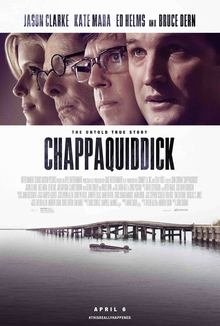
Something Cult, Foreign-Language or Indie #182: Chappaquiddick (2017).

Chappaquiddick (film).png

On 18 July, 1969, US Senator Ted Kennedy left a party on Chappaquiddick Island with his late brother Robert's 28-year-old former secretary Mary Jo Kopechne. Very shortly later, Kennedy accidentally drove his car off a bridge over Poucha Pond. He managed to escape, but left Kopechne there to drown and failed to report the accident for a day. The film Chappaquiddick gives a glimpse into what may have happened next as the Kennedys tried to deal with it.

This is a watchable but very uneven movie. Director John Curran, whose previous film was the stunning Tracks (2014), and writers Taylor Allen and Andrew Logan deserve kudos for bravely seeking to add more of the pieces of what remains, 50 years later, an incomplete puzzle, and numerous scenes are thoroughly compelling and balanced, but unfortunately they're sandwiched between others that couldn't have been handled more monotonously and almost derail what I think is the film's intended effect: to encourage the viewer to play armchair detective before and after the credits roll.

Queensland's own Jason Clarke is effective as Kennedy, with Bruce Dern and Ed Helms backing him up solidly as Joseph Kennedy, Sr. and Ted's cousin Joe Gargan respectively, but Kate Mara is wasted as Kopechne. It is delicately and patiently shot and edited, but Garth Stevenson's score is intrusive and stale. Overall, Chappaquiddick is reasonable but as far as movies about the Kennedys go, it's no match for JFK or Jackie.

Why I (really) love The Lord of the Rings.

Alright. Here it finally is. What I claimed in February to be telling you, although as you know there was a sincere reason for why I lied to you then. A summary of why I love The Lord of the Rings, on both paper and film.

I feel I should start with the films, purely because they were my first exposure to Middle-earth and I was 13 when The Fellowship of the Ring came out. I saw it theatrically, and I left that theatre a very different kid to the one who entered it. (Ironically now, I was very anxious the night before I saw it, because I'd never seen such a long movie at the cinema before. But obviously, I ended up wishing it were even longer.) Everything about it just entranced me: the visuals, the music, the story, even the acting and direction. I was immediately as attached to it as Gollum is to the One Ring. Then, while awaiting the next two films (which amazed me just as much and still do), I read the book. That took me just over a year after I bought the unabridged, three-volume film tie-in edition (which I still have, of course), and it cemented my fandom. Tolkien's writing is understandably divisive, but it absorbs me thoroughly because of its intense, maybe pedantic descriptiveness which I consider essential for most high fantasy, and he (alongside C. S. Lewis, his Oxford colleague) had to invent modern fantasy in general practically individually. From there, I read The Hobbit, The Silmarillion, The Children of Hurin and The Fall of Arthur, all great books.

Professor Tolkien established the literary subgenre of mythopoeia; basically one whose narrative contains an entirely fictional and ancient history. The level of detail, consideration, intellect, time (real and imagined), inspiration (The Hobbit was originally a bedtime story he told to his young children, and many of the characters in his works were based on people he fought with in World War I) and enthusiasm Tolkien infused his tales with just give them a scale and power that is undeniable no matter how you feel about his writing, how many imitations it has spawned, or whether you like the fantasy genre in general.

That scale and power gradually gave it a reputation as an unfilmable work (even Tolkien himself considered it that, and subsequently sold the film rights for only $15 000). Ralph Bakshi tried and failed to disprove that reputation with his 1978 animated adaptation which flopped commercially and critically, and only told half the story anyway. But then, of course, one Peter Jackson achieved the unthinkable over 20 years later. His trilogy became the most lucrative in film history to that point, won 17 Oscars from 30 nominations, put his native New Zealand on the global map as a tourism and filmmaking hot-spot, and made Tolkien's novels commercially hot again.

Maybe it's because I'm a proud nerd, or because my conditions have given me a taste more for the overtly visual and imaginative, but in honesty I simply can't briefly, concisely or coherently express all the reasons why I'm such a huge fan of The Lord of the Rings after all. Fuck, I can't even articulate how much I love it. But then again, by this point, I guess I don't even need to. Now, if you'll excuse, I have to go and find... myyyyy... preccccccioussssss!


Something Cult, Foreign-Language or Indie #182: The Descent (2005).

The Descent (2005) - IMDb

A year after losing her husband (Oliver Milburn) and daughter (Molly Kayll) in a car crash returning from a white water rafting adventure, Sarah (Shauna Macdonald), is reunited with her friends Juno (Natalie Mendoza), Beth (Alex Reid), Sam (MyAnna Buring) and Rebecca (Saskia Mulder), with newcomer Holly (Nora-Jane Noone), for a caving trip in the Appalachians. After spending their first night there in a log cabin, the women set off for what they think will be a pretty routine trek. But once they're deep inside the cave and a narrow passage behind them crumbles, they're trapped inside. And they're not alone...

Writer-director Neil Marshall's The Descent is unquestionably one of the best, and scariest, horror films of this century yet. After his breakthrough 2002 film Dog Soldiers, which I've not seen, following suggestions from his manager he consciously decided to make a horror flick with all female characters so he could explore their relationships more deeply, and because horror casts are usually mixed. Marshall also gave them different accents to further distinguish each one. Anyway, he takes just the right amount of time to establish the characters and their predicament and does that calmly enough to ensure he can whip-start your heart rate later, and his direction certainly does that for me.

All the actresses are solid, but Macdonald and Mendoza particularly give convincing and affecting performances, generating so empathy from the viewer that you want to shout at them about where they should go to escape, and their cave is stunningly realised. It was created on a soundstage at Pinewood Studios because filming in a real cave was considered too dangerous and impractical, but you'd never know that from looking at the cave; I sure didn't. Overall, this is an exceptionally suspenseful, adrenaline-pumping, resonant and relevant thrill ride. Its title is ultimately ironic, because this Descent is really, in terms of quality, an ascent.

Saturday, 28 March 2020

Something Cult, Foreign-Language or Indie #181: 13th (2016).

13th (film).png

In this Oscar-nominated 2016 documentary, director Ava DuVernay explores the history of race and mass incarceration in the United States. It's named after the Thirteenth Amendment to the US Constitution which abolished slavery, but DuVernay film argues slavery has endured in the American judicial system.

I had hopes for 13th as I loved Selma, DuVernay's 2014 narrative film about the 1965 march for African-American voting rights, and because of its acclaim; however, I'm afraid it fell way short of living up to that for me, and for two big reasons. Firstly, maybe it's because of the Netflix presentation but visually, her approach here just feels much too glossy and vibrant for a coverage of this subject matter. Secondly, I found it increasingly unsure of whether it wanted to be a study of contemporary prison life for incarcerated African-Americans, with all the unfair and racist treatment that makes them face, or a full history of American race relations in and out of the US judicial system. Both of those themes deserve and need a full film to themselves, but this film tries to intertwine them and suffers as a result. I ultimately found it sincere but quite convoluted and misjudged.

Something Cult, Foreign-Language or Indie #180: Don't Look Now (1973).

Dont look movieposter.jpg

Laura and John Baxter (Julie Christie and Donald Sutherland) are grieving the drowning death of their daughter Christine (Sharon Williams) in an accident at their English country home. To try move on, they accept an offer for John, an architect, to help restore a cathedral in Venice. Once there, Julie meets sisters Heather (Hilary Mason) and Wendy (Clelia Matatania) at a restaurant; Heather is blind and psychic but claims to be able to "see" Christine, a revelation that shakes Laura profoundly. She then tells John of this but he immediately dismisses their claims, only to soon encounter some very mysterious and increasingly violent sightings himself. Meanwhile, Laura joins the sisters for a seance, before seemingly disappearing. In trying to unravel this deepening mystery, Laura and John become very precariously embroiled in it themselves.

This adaptation of a Daphne du Maurier short story is fully worthy of its status as a classic of horror and British filmmaking. Director Nicolas Roeg vividly and lucidly invokes the beautiful Venetian scenery (the canals and rowboats are naturally ubiquitous) to visually express what our heroes are longing to restore to their lives - a sense of peace - and very insightfully lifts the location's veil slowly to reveal the true threat it possesses underneath its luxurious street levels. Chris Bryant and Allan Scott's sensitive and patient screenplay effectively navigates the urgency and estranged intimacy of the Baxters' relationship before it goes literally to horror, and Christie and Sutherland (who share a famously steamy sex scene which was hugely controversial upon release) both never hit a false note. (Mind you, Sutherland's hairdo here can stay in 1973.) Don't Look Now had an initially mixed reception, but in 1999 it was voted the eighth-greatest British film ever made and I can see why. It is thoroughly atmospheric, chilling, tastefully sexual and flawlessly plotted and executed. Trust me, you do want to look now.